
What VO2max testing actually tells you (and what it does not)
VO2max is the number people quote at the coffee stop. It is also, for most athletes, the least useful thing a metabolic test produces.
That is not a criticism of the test. It is a criticism of which number everyone fixates on.
What the number actually is
VO2max is the maximum rate at which your body can take in oxygen, transport it, and use it to produce energy. It is expressed in millilitres of oxygen per kilogram of body weight per minute.
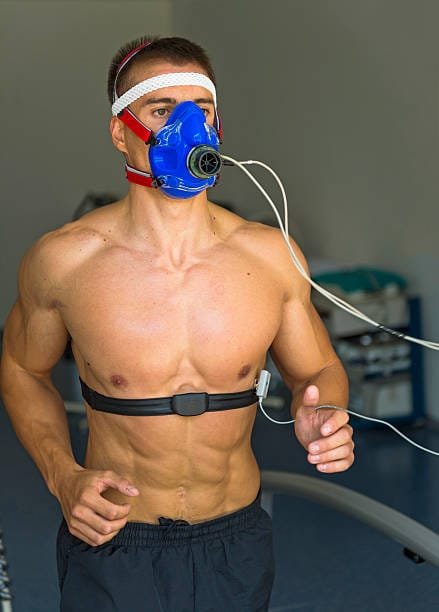
To measure it properly you have to actually reach it. You ride, run or row a graded test to exhaustion while breathing through a mask that measures the volume and composition of every breath. As intensity climbs, oxygen uptake climbs with it – until it stops climbing while the workload keeps going up. That plateau is your ceiling.
It is a real physiological limit, and it is genuinely interesting. It is also largely set by genetics and training history, and it moves slowly. Most trained athletes will shift it a few per cent over a season of hard work. Untrained people improve much more, because they start further from their own ceiling.
So if you are already training seriously, chasing your VO2max number is chasing the least movable thing in the room.
The numbers that actually change your training
Underneath the ceiling sit two thresholds, and these are where the useful information lives.
The first threshold – the aerobic threshold, or first ventilatory threshold – is the intensity at which your body first starts working noticeably harder to clear the by-products of effort. Below it, you can go almost indefinitely. It marks the top of genuinely easy riding.
The second threshold – the anaerobic threshold, or the intensity often loosely called functional threshold – is the highest intensity you can hold in a metabolic steady state. Above it, the clock starts running and fatigue accumulates in a way that will end the effort.
These two numbers define your training zones. Not a percentage of a formula. Not 220 minus your age. Not a twenty-minute field test multiplied by 0.95 and hoped for the best.
And unlike VO2max, thresholds move. Substantially. A well-structured block can shift your second threshold meaningfully in eight to twelve weeks, which is exactly why measuring it is worth doing and worth repeating.
Two riders, same ceiling, different training
Take two riders with an identical VO2max. One holds their second threshold at 88 per cent of it, the other at 75 per cent.
The first rider is close to fully expressing their engine and needs work at and above threshold to make further progress. The second rider has a large gap between what their body can theoretically do and what they can actually sustain, and needs volume and sub-threshold work to close it.
Same headline number. Opposite training prescriptions. If all you have is the VO2max figure, you cannot tell these two riders apart – and there is a fair chance you will give both of them the same programme and wonder why only one improved.

Fat, carbohydrate and the fuelling question
The same mask that measures oxygen uptake also measures carbon dioxide output, and the ratio between them reveals what you are burning at any given intensity.
This produces two practically useful things. First, the intensity at which you oxidise fat fastest, which is genuinely relevant if you are preparing for long events. Second, and more importantly, an estimate of how many grams of carbohydrate per hour you are actually using at race intensity.
That second number is the one that turns fuelling from guesswork into arithmetic. If you are burning a known amount per hour and taking in far less, the bonk is not a mystery or a mindset problem. It is a subtraction.
Resting metabolic rate
Resting metabolic rate is measured separately, lying still, in the morning, having not eaten. It tells you what your body burns simply existing.
It matters for two groups in particular. Athletes trying to change body composition without wrecking their training, who need to know their actual baseline rather than a calculator estimate. And athletes who have been under-eating for a long time, in whom a suppressed resting rate is one of the clearer objective signals that something has gone wrong.
What a test session involves
Testing is done on the modality you compete in – cycling, running or rowing – because the numbers do not transfer cleanly between them. A cyclist tested on a treadmill gets a number that is interesting and not very useful.
You warm up, then work through a graded protocol with the workload stepping up at fixed intervals while you breathe through the mask. The final stages are genuinely hard; that is the point. Total time on the equipment is usually somewhere between twenty and forty minutes depending on the protocol and how the day is going.
Preparation matters more than people expect. Arriving glycogen-depleted, dehydrated, caffeinated at the wrong time, or two days after a hard block will move your numbers – and you will then train off numbers that describe a version of you that only existed on a bad Tuesday.
That is why lab testing is booked by phone rather than online. There is a short conversation to have first about what to eat, what to avoid, and when to schedule it relative to your training.
How often is worth it
Twice a year suits most people: once at the start of a training block to set zones, once after it to see whether the block did what it was supposed to.
Testing more often than that rarely changes a decision. Testing less often means you spend a season training to zones that expired.
Where this connects to everything else
A metabolic test tells you how much power you can produce and for how long. An aero test tells you what that power actually buys you in speed. A bike fit determines whether you can hold the position that makes both of those true for more than twenty minutes.
They are three views of the same question, which is why it helps to have them done by the same person.
Want your actual numbers rather than an estimate? Book an appointment at UpHill Performance, or call 0438 284 788 for lab testing.
Want this looked at properly?
Physiotherapy, bike fit, aero testing and metabolic testing in Wright, ACT.