
Why a bike fit should start with comfort, not aerodynamics
Every rider who books a fit wants to be faster. The instinct is to go straight for the aggressive position – lower bars, longer reach, narrower elbows. It looks right in photographs, and photographs are where most people form their idea of what fast looks like.
The problem is that a position only produces speed if you can actually hold it, at race intensity, for the duration of the event, without your body quietly sabotaging you to escape it.
The order that works
Comfort. Then efficiency. Then aerodynamics.
Not because comfort is more important than speed, but because comfort is what makes the other two possible. Each stage is built on the one before it, and skipping down the list produces a position that measures well and rides badly.
Comfort means the position is sustainable. No numbness, no hot spots, no neck or lower back pain at the end of a long ride, no unconscious shifting around to get away from a pressure point.
Efficiency means the position lets you produce power well. Hip angle open enough to breathe and to let the glutes contribute. Knee tracking cleanly. Foot stable on the pedal. Nothing fighting the pedal stroke.
Aerodynamics means the position is as slippery as it can be, given the first two.
What happens when you invert the order
Slam the bars first and the body responds in ways that are easy to miss on a trainer and impossible to miss at kilometre eighty.
- You sit up. Not deliberately – the moment the effort gets hard, the hands come to the tops and the low position is abandoned exactly when it was worth the most watts.
- Your hip angle closes. A closed hip angle limits how much the glutes can contribute and restricts the diaphragm. Power drops, breathing gets shallower, and it feels like a fitness problem.
- You rotate forward onto the perineum. Which is where the numbness comes from, and the numbness is what makes the rider shift, and the shifting is what wrecks the consistency of the pedal stroke.
- Your neck extends further. To keep your eyes on the road you have to look further up out of the position. Over hours, that is a well-known route to neck and upper back pain.
The rider then reports back that the new position is slower. It is not that aerodynamics does not work. It is that they never actually rode in the position they paid for.
The trade is real, and it is measurable
None of this is an argument against aggressive positions. Plenty of riders can hold a low position beautifully, and for them it is free speed.
The point is that the trade-off between drag and sustainable power is a genuine physical trade-off with a genuine optimum, and the optimum is different for every rider. It depends on hip mobility, hamstring length, thoracic extension, core endurance, event duration and, quite often, on injury history.
The only honest way to find that optimum is to test it rather than assume it. This is exactly the case for measuring drag: an aero test can tell you what a five millimetre drop is worth, and you can then decide whether it is worth what it costs you in comfort. Without the number, you are trading blind in both directions.

Why the fit happens on a fit bike
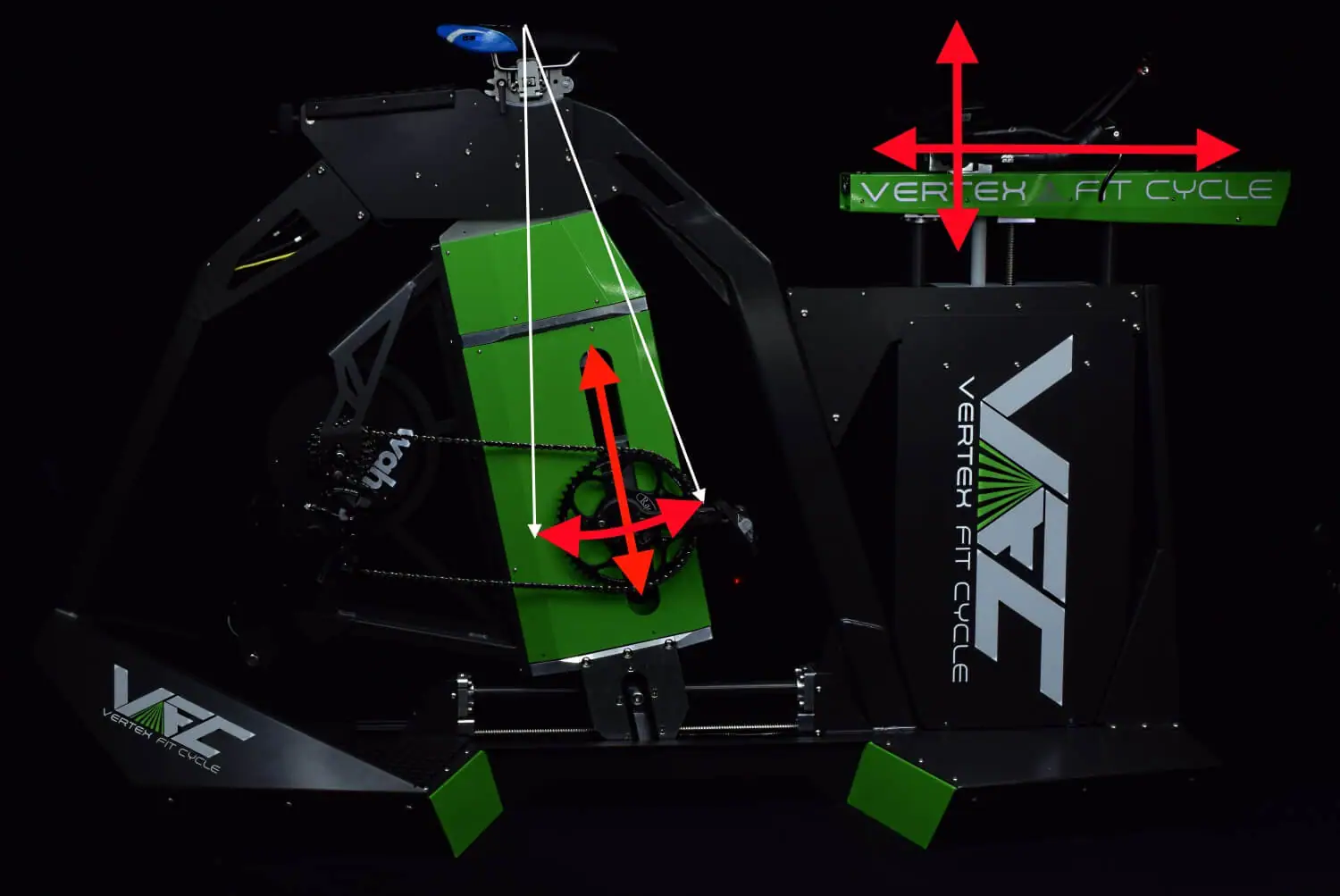
Fitting is done on a Vertex Fit Cycle, where the contact points move around a stationary rider rather than the rider being repeatedly moved around a static bike.
That sounds like a detail. It is not. On a normal bike, changing saddle height means stopping, getting off, undoing a clamp, guessing, getting back on, and warming up again. In practice that limits you to a handful of changes in a session, each one separated by enough time that you cannot really remember how the last one felt.
On a fit bike the geometry moves while you keep pedalling. Two positions can be compared within seconds of each other, which is the only reliable way for a rider to feel a small difference. It also means we can arrive at the numbers before deciding what parts you need, rather than working backwards from the stem you happen to own.

The physio part
A fit is a conversation between the bike and the body, and the body half is often the half that needs the work.
Sometimes the right answer is not to change the bike at all. If a rider cannot hold a position because of a hamstring restriction or a genuinely stiff thoracic spine, moving the bars up is a workaround, and eight weeks of targeted work is a solution. If knee pain is coming from the way the foot is loading rather than from saddle height, no amount of saddle adjustment will fix it.
Being a physiotherapist as well as a fitter means those cases get named instead of being handed back as an unsolved fit. It also means the follow-up is rehabilitation rather than another guess at stem length.
What a fit involves
An interview first: what you ride, how far, how often, what your goals are, and every ache you have learned to live with. The aches matter more than people volunteer, because riders normalise discomfort remarkably quickly.
Then a physical assessment off the bike – mobility, stability, leg length, foot posture, injury history – so that what happens on the bike is interpreted against what the body can actually do.
Then the fit itself, working through cleats and foot correction, saddle height and setback, saddle choice, and finally reach and drop. Adjust, ride, feel, compare, repeat.
You leave with the coordinates written down, so the position can be reproduced on any bike, and with a clear list of anything that needs work off the bike.
When to get one
Before you buy a bike, not after – a fit tells you what size and geometry you should be shopping for, and that is a far more expensive mistake to make than a fit costs to avoid.
After any persistent niggle that shows up on the bike and settles off it. And before an aero test, always, because optimising a position you should not be in is a very precise way of getting the wrong answer.
Want this looked at properly? Book a bike fit at UpHill Performance.
Want this looked at properly?
Physiotherapy, bike fit, aero testing and metabolic testing in Wright, ACT.