
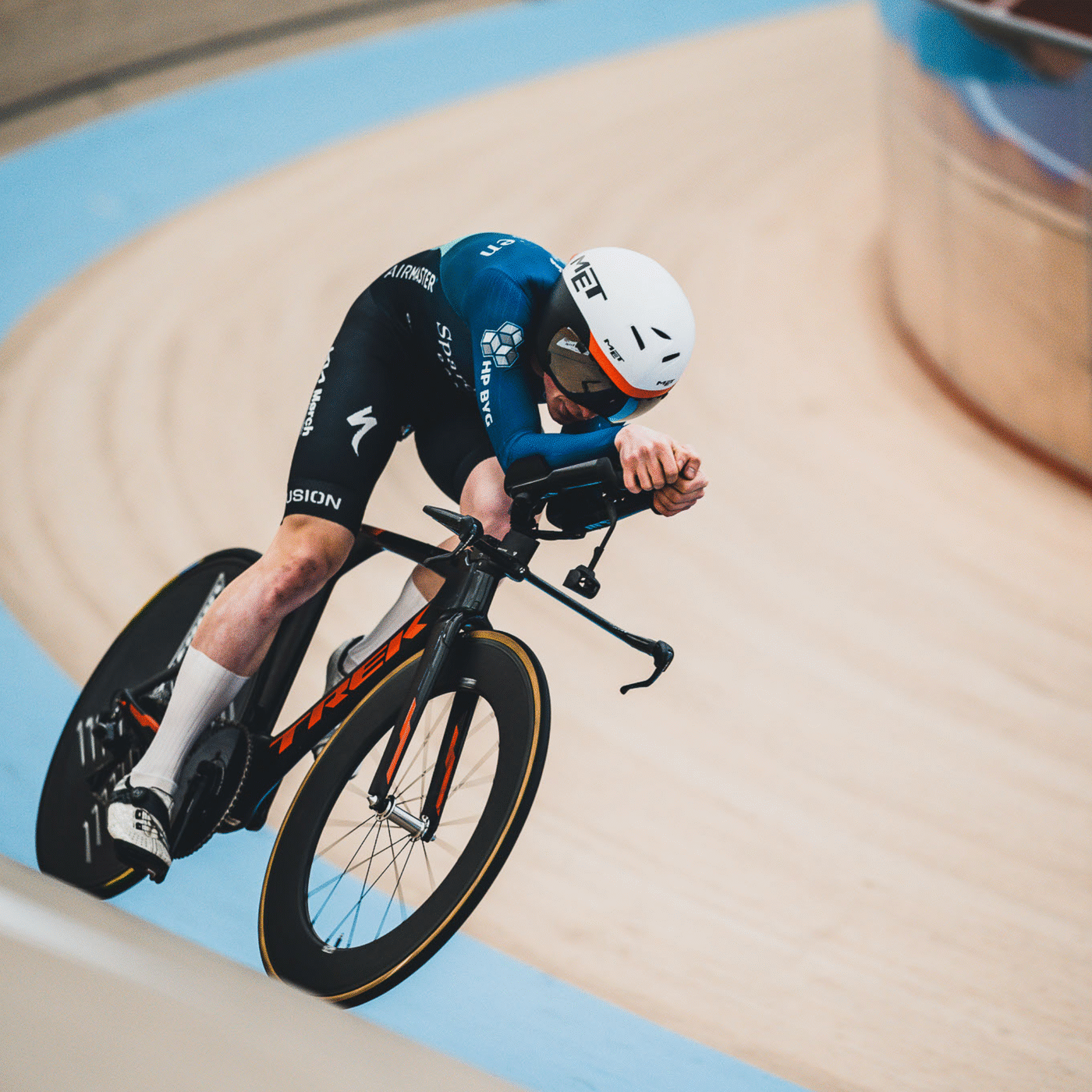
How field aero testing works, and why CdA beats guesswork
Above roughly 30km/h, the overwhelming majority of the power you produce goes into pushing air out of the way. Rolling resistance, drivetrain losses and gravity on flat ground are rounding errors by comparison. By 45km/h it is closer to nine tenths of your output.
Which makes it strange that most riders have never measured it. We will happily spend two thousand dollars on wheels on the strength of a manufacturer claim, and never once check what the whole system – bike, kit, and the large irregular object sitting on top of it – actually costs us in the air.
What CdA is, in plain terms
CdA is your drag coefficient multiplied by your frontal area. One number, measured in square metres, describing how hard the air is fighting you.
Frontal area is the easy half: how big a hole you punch. Drag coefficient is the awkward half: how cleanly the air closes back up behind you. You can have a small frontal area and still be slow, because the air is tumbling off your shoulders into a mess of turbulence behind your back. This is why simply getting lower is not automatically faster.
For rough orientation, a rider on the hoods on a road bike typically sits somewhere around 0.35 to 0.40. In the drops, nearer 0.30. A well set up time trial position often lands between 0.20 and 0.25, and the fastest riders in the world go below that. Those are ballpark figures, not targets – your numbers depend on your build, your bike and your flexibility.
What matters is not where you start. It is that a change of 0.01 is worth roughly ten watts at time trial speed. Find three of those and you have found a different rider.
Why drag is so hard to guess
Aerodynamics is deeply unintuitive, and the sport is full of confident advice that turns out to be wrong for a specific rider.
- Narrower bars are usually faster, until the rider cannot breathe properly and loses more in power than they gain in drag.
- A deeper front wheel helps some riders and does very little for others, depending on how the air is already behaving by the time it reaches the frame.
- Two skinsuits that look identical can differ by more than a wheel upgrade, purely on fabric and seam placement.
- Moving a bottle can be worth more than a helmet. Sometimes it is worth more with a bottle than without.
None of that is knowable from a photograph or a rule of thumb. It has to be measured on the actual rider, on the actual bike, with the actual kit.

How it gets measured outdoors
The Aerosensor sits at the front of the bike and reads air speed and yaw angle – how fast the air is arriving, and from what direction. Paired with your power meter, it accounts for the power going into acceleration, climbing and friction. What is left over is the power going into the air, and from that, your live CdA.
Aerosensor publishes expected repeatability of 1.5 per cent for out-and-back road testing, 1 per cent at an outdoor velodrome and 0.5 per cent at an indoor velodrome, the velodrome figures using the Aerodrome lap trigger. Those hold while average wind is below a quarter of your road speed; above half, testing is not recommended. All of it on the roads you actually race on, in the wind you actually race in.
The repeatability number is the important one. An aero test is not really a measurement of a position; it is a comparison between two positions. If the noise in your measurement is larger than the difference you are hunting, the test tells you nothing. One and a half per cent on a 0.25 CdA is about 0.004 – still comfortably smaller than any change worth making, and it tightens further on a track.

What a session actually looks like
We start with a baseline in your current position and current kit, so every later number has something to be compared against.
Then we run repeated efforts, out and back, with a lap trigger marking each run identically. Out and back matters: it cancels most of the effect of a steady wind and any slope in the road. Repeated matters: one run is an anecdote, several runs are data.
Then we change one thing. Only one. Hand position, or helmet, or the bottle, or the skinsuit. Run it again. Compare. That discipline is the whole method – the moment you change two variables at once, you have lost the ability to attribute the result to either of them.
A typical session gets through six to ten comparisons. You leave knowing which changes bought watts, which did nothing, and – this happens more often than people expect – which of the things you already paid for are actually costing you.
Simulation, wind tunnel, and field testing
There are three ways to get a CdA number, and they answer different questions.
AI-driven CFD services generate a CdA from photographs. They are genuinely useful and can be accurate for position, and they are cheap and fast. Their limitation is scope: they work from an assumed value for the bike rather than your bike, and they cannot evaluate anything about fabric, surface or texture. Skinsuits, socks, calf sleeves and overshoes are invisible to them.
A wind tunnel is the reference standard, controls everything, and is the most expensive option by a distance. There is not one in Canberra.
Worth noting on that comparison: Aerosensor report that when they tested discs of known drag in both a wind tunnel and an indoor velodrome, the system resolved changes equivalent to just 2 watts at 50km/h, which they describe as exceeding conventional wind tunnel precision. That is their figure, measured indoors under controlled conditions. On the road the number that matters is the 1.5 per cent repeatability above.
Field testing measures the whole system as it exists, in real air, including every item of clothing and every bottle. It is the only one of the three that can tell you whether the expensive skinsuit is actually faster than the cheap one.
The sensible sequence, if you have the appetite for all three, is to simulate to narrow the search, then measure to be sure.

Who it suits
Time triallists and triathletes first, because they spend the most time alone in the wind and the gains compound over every kilometre.
Then anyone about to spend real money on aero equipment. Testing before buying a disc wheel routinely saves more than the session costs, either by confirming the purchase or by killing it.
Road racers and gravel riders benefit less directly, but the same principles apply on any long solo effort, and the position work carries over.
Get the fit right first, though. Testing an unfitted position wastes the day – you will optimise a shape you should not have been in to begin with. That is why a bike fit comes before a test, and why comfort comes before aerodynamics inside the fit itself.
What to bring
Your bike, exactly as you race it. Every helmet you own. Every skinsuit and jersey you might race in. Overshoes, socks, calf sleeves, the lot. Race wheels and training wheels if you have both.
If you are curious whether an item is fast, bring it. The marginal cost of testing one more thing during a session you are already running is close to zero.
Want this looked at properly? Book an appointment at UpHill Performance.
Want this looked at properly?
Physiotherapy, bike fit, aero testing and metabolic testing in Wright, ACT.